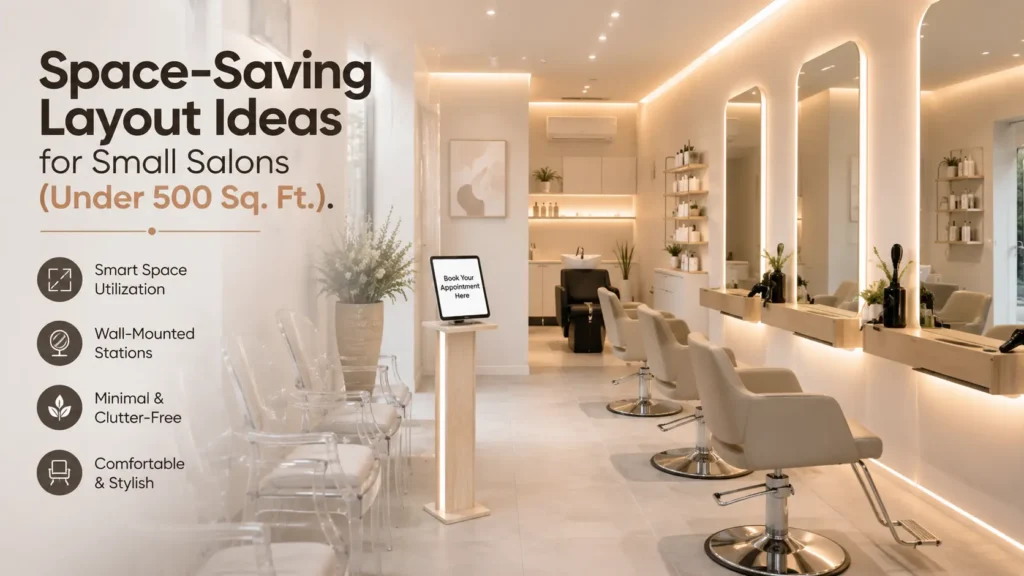

Introduction: The Age of the High-Performance Micro-Studio
As we navigate the economic realities of 2026, the landscape of the professional beauty industry has shifted from “bigger is better” to “smarter is richer.” In high-density urban corridors like South Delhi, Bandra, or Indiranagar, real estate prices have reached a boiling point. The traditional 2,000-square-foot salon model, once the symbol of success, is now often seen as a liability due to massive overheads and underutilized space. The most profitable business model emerging this year is the high-yield micro-studio. However, making a 300 to 500 square foot space look, feel, and function like a 5-star spa requires more than just a coat of paint—it requires a masterfully engineered small salon layout.
A small salon layout is a complex puzzle of ergonomics, aesthetics, and operational flow. In a restricted footprint, every square inch must justify its existence in terms of revenue generation. If you have a corner dedicated to paper files, a bulky desk for a receptionist, or a stockroom overflowing with unused product, you are effectively paying rent for “dead space” that could be generating profit. 2026 is the year we stop being just “decorators” and start being “spatial engineers.”
In this 1750-word masterclass, we will deconstruct the blueprint of a high-conversion studio. We will explore how the “Invisible Reception” powered by Lokaci Pro can reclaim your floor space, how the Zubito supply chain eliminates the need for stockrooms, and how to hire a “lean” elite team via the Stylelink app. Whether you are a startup entrepreneur or a seasoned owner looking to downsize for better margins, this is your definitive guide to maximizing space and revenue.
The Bench Mark: Brands like The Salon Company have become the industry standard for this model, proving that premium services and clinical hygiene can thrive in a compact environment when the small salon layout is optimized for efficiency. (Pro Tip: To staff a micro-salon with experts who are tech-savvy and multi-skilled, the Stylelink app is the only platform that filters for high-value talent).
Phase 1: The Physics of Sightlines—Why Mirrors are Architectural Tools
In a small salon layout, the goal is to prevent the client’s brain from registering the physical boundaries of the room. This is achieved through “Sightline Engineering.” If an eye can travel 20 feet without hitting a solid wall, the room feels expansive. If it hits a partition at 5 feet, the room feels like a closet.
1. The “Infinity Wall” Concept
Instead of individual mirrors for each station, use one continuous mirror wall that spans the entire length of the styling area. In a narrow small salon layout, this doubles the perceived width of the room. By using floor-to-ceiling glass, you remove the horizontal lines that “shorten” a room’s height. This is a hallmark of The Salon Company‘s aesthetic—blending utility with an illusion of endless space.
2. Abolishing Solid Partitions
If you need to separate the hair-wash area from the styling floor, never use a brick-and-mortar wall. Use fluted glass, industrial metal mesh, or even vertical wooden slats. These materials provide “Functional Privacy” (the client feels tucked away) without breaking the visual flow of the small salon layout. Light continues to travel through, keeping the entire studio bright and airy.
Phase 2: The “Invisible Reception” and the Power of Lokaci Pro
The single most inefficient use of space in a 20th-century salon was the reception desk. It typically occupied 40 to 60 square feet—room enough for an entire additional styling chair or a manicure station. In 2026, the reception desk is an antique. By adopting Lokaci Pro, you move to a “Desk-Free” model.
Reclaiming Floor Space for Revenue
Lokaci Pro is a cloud-based salon software that operates on tablets and smartphones. Here is how it physically alters your small salon layout:
- Chairside Checkout: Stylists can handle billing, re-booking, and retail upsells directly at the styling station. There is no need for a “queue” at the front door.
- Digital Locker: You no longer need cabinets for client cards, tax invoices, or staff attendance registers. Everything is in the cloud. This frees up crucial wall space for beauty parlour decor or vertical retail displays.
- Automated Check-in: Clients receive a WhatsApp link to check in as they arrive, alerting the stylist’s phone immediately. The “Waiting Lobby” can be reduced to a single luxury armchair rather than a bulky sofa.
By removing the desk, you are maximizing space for a high-margin nail bar or a hair-extension corner. In a premium market, one extra chair can increase your monthly top-line by ₹1.5 to ₹2 Lakhs.
Phase 3: The “Lean Inventory” Revolution via Zubito
Most small salon layout designs are ruined by a massive stockroom. Owners often buy 50 liters of shampoo or 200 boxes of hair color to save on bulk discounts, then waste ₹5,000 worth of monthly rental space just to store them. This is a “Storage Trap.”
Lean Management with Zubito Supply:
Because Lokaci Pro is natively integrated with the Zubito ecosystem, your inventory tracking becomes microscopic. The software knows exactly how many grams of color were used in every service. When a specific shade hits a “Low Stock” trigger, the system automatically places an order on Zubito for next-day delivery.
This “Just-In-Time” supply chain means you only need an “Active Cabinet” on the salon floor. You can now convert that old, dingy 60 sq. ft. stockroom into a high-ticket, private treatment room for HydraFacials or Botox Hair Treatments. Turning a storage room into a service room is the ultimate trick for maximizing space and skyrocketing your spatial ROI.
Phase 4: Hiring Multi-Disciplinary Talent via Stylelink
In a 1500 sq. ft. salon, you can afford a specialist for every task. In a small salon layout, every staff member must be a “High-Value Multi-tasker.” You need artists who can consult, cut, color, and manage their own digital client relationships.
Staffing the High-Yield Footprint
When you recruit through the Stylelink app, you aren’t just looking for a “beautician.” You are looking for a “Boutique Specialist.” Stylelink’s visual portfolios and verified certification tracking allow you to find “Hybrid Professionals”—for example, a Senior Hair Stylist who is also certified in Nail Art Designs or Eyebrow Threading.
In a micro-salon, if your hair chairs are empty but your nail demand is high, your versatile staff can shift focus, ensuring that your small salon layout is always producing revenue. Stylelink empowers you to build this flexible, elite team that respects the limitations and opportunities of a boutique space.
Phase 5: Verticality and Lighting—The 3D Small Salon Layout
Most owners only think of their floor plan in 2D. To truly master maximizing space, you must think in 3D. Vertical space is your secret weapon for storage and beauty parlour decor.
- The Floating Sation: Use wall-mounted styling stations with no legs. When a client can see the floor extending all the way to the wall under the station, the small salon layout feels 20% larger. It also makes cleaning much faster.
- Cove & Perimeter Lighting: Avoid one large, central chandelier. It draws the ceiling down. Instead, use LED cove lighting along the perimeter of the ceiling. This “washes” the walls with light, pushing them back visually. Pair this with 5000K neutral-white task lighting at the mirrors to ensure hair color for women services are performed with perfect color accuracy.
- Aesthetic Vertical Storage: Use floor-to-ceiling glass shelving for retail. It doesn’t block the light, keeps products at eye level (increasing sales), and acts as beautiful beauty parlour decor.
Operational Zoning: The “Wet-to-Dry” Workflow
In a tight small salon layout, collisions are a risk. You must organize your zones based on plumbing and duration of stay. Here is the scientifically optimized 500 sq. ft. zone map:
| Zone | Location | Spatial Optimization Hack |
|---|---|---|
| The Welcome Zone | Immediate Entrance | Replace bulky sofa with two sleek accent chairs and a digital iPad check-in. |
| The Cutting Island | Natural Light Source | Use double-sided mirrors in the center to serve two clients in one footprint. |
| The Color Bar | Opposite Styling | Use a wall-mounted “Color Lab” with integrated sinks to avoid staff walking to the back. |
| The Wet Sanctuary | Farthest Corner | Use “Lie-flat” European backwash units; they occupy 15% less length than traditional chairs. |
| The Clinical Cabin | Converted Stockroom | Soundproofed room for high-margin facials, made possible by Zubito‘s lean supply. |
Beauty Parlour Decor: The “Quiet Luxury” Palette
Color choice can either “expand” or “collapse” your small salon layout. In 2026, the trend is “Monochromatic Minimalism.”
The Neutral Expansion Rule:
Use different textures of the same color for the floor, walls, and ceiling. When there is no harsh line between the floor and the wall, the brain struggles to identify where the room ends. Soft whites, warm greiges, and pale sands are perfect. Use dark colors (like matte black or deep gold) only for hardware—taps, handles, and frames—to add “expensive” contrast without shrinking the space.
Furniture Engineering: The “Transformative” Pieces
Stop buying furniture meant for 2000 sq. ft. salons. For a small salon layout, you need bespoke or slimline engineering:
- Swivel-Arm Manicure Tables: These attach directly to the styling chair. The client can get their nails done while their hair color is processing. This eliminates the need for a separate nail zone, doubling the utility of your styling floor.
- Retractable Hair Dryers: Ceiling-mounted dryers that pull down when needed and retract when finished. This keeps your floor clear of tangled wires and bulky stands.
- Nesting Chairs: If you do have a small waiting area, use stools that nest under a central table to keep the aisle clear when not in use.
Conclusion: Small Footprint, Massive Future
The boutique salon revolution of 2026 is driven by one thing: Efficiency. A small salon layout is no longer a restriction; it is a strategic advantage. By eliminating the “bloat” of traditional management—the heavy desks, the paper records, and the excessive inventory—you create a leaner, faster, and more profitable business. You offer your clients an intimate, exclusive experience that the large “hair factories” simply cannot replicate.
However, spatial luxury requires a digital backbone. You cannot maximize a 400 sq. ft. space if you are still working with 1990s tools. Professionalize your boutique studio today. Reclaim your floor space by switching to the paperless Lokaci Pro. Erase your stockroom by tapping into the Zubito supply chain. And build an elite, versatile team through the Stylelink App.
Follow the clinical, high-yield path set by The Salon Company and prove that in the beauty business, it’s not the size of the salon that matters, but the intelligence of the layout. Your boutique empire starts now!
Frequently Asked Questions (FAQs)
Q1: Is it better to have more chairs or more walking space?
In a small salon layout, balance is key. If you cram 5 chairs into 400 sq. ft., the energy becomes frantic and loud. Aim for “High-Yield Density”—3 styling chairs with multi-functional attachments (like manicure arms) usually produce more revenue and higher client satisfaction than 5 cramped stations.
Q2: How do I handle the noise level in a small boutique salon?
Noise is the biggest psychological “shrinker.” To keep the space feeling peaceful, use acoustic ceiling panels, heavy drapes for the facial area, and “Silent” hair dryers. Avoid loud, high-energy music; opt for low-frequency ambient sounds that mask conversation without overwhelming the room.
Q3: How much does an optimized salon setup cost?
While bespoke, wall-mounted furniture and high-end salon software like Lokaci Pro require an initial investment, the long-term ROI is massive. You save on rent (by needing less space), you save on stock (via Zubito), and you increase re-booking rates through the premium, intimate experience you’ve created.


